Code to Production 08: Operations, Rebuilds and What Production Would Change
A delivery system is done when someone else can run it, renew it and rebuild it from Git, not when it first deploys. eShop's runbooks, scripts and rebuild document all live in eshop-infra, so the whole system can be recreated from the repositories. This closer covers the runbooks, Renovate, the credential map, troubleshooting, and the honest list of what's lab-only.
Code to Production: the series
- The system on one page
- Ways of working
- CI gates before review
- Image gates and the supply chain
- Delivery and releases
- The platform
- Observability
- Operations and caveats (this post)
Runbooks live beside the scripts they drive
Every eShop runbook is a file in eshop-infra, next to the script it operates. A runbook in a wiki drifts; a runbook in the repository is reviewed in the same merge request as the change that makes it wrong.
File in eshop-infra | What it covers |
|---|---|
clusters/eshop-prd1/README.md | the cluster, CI's kubeconfig, deploys, signatures and key rotation, watchdog, pull-based deploys, alerts |
docs/gitlab-ci.md | runners, starting a pipeline by hand, the job token allowlist, a new service project, Renovate |
docs/git-workflow.md | merge requests, release candidates, sign-off, promotion, rollback, patches |
docs/rebuild-on-a-new-environment.md | recreating everything on a new environment |
docs/supply-chain.md | every supply-chain control on one page, and what is not done |
Each runbook names one starting point, says who may run each step, and ends with a check. None of them says "make sure everything is fine". Three are worth copying as they are.
A deploy that waits for Flux, and says which part stopped
The deploy job changes nothing on the cluster. scripts/ci/deploy-eshop-prd1.sh renders the manifests, publishes them to Harbor signed with eShop's key, then waits until Flux reports that exact digest applied (post 05 has the design, ADR 0017). Here's a deploy-dev job:
--- publish clusters/eshop-prd1/apps/dev for the cluster to pull
tlog entry created with index: 4049358337
published <HARBOR>/eshop/eshop-manifests@sha256:81483203eb11...
--- wait for Flux to apply it (Kustomization eshop-ci/eshop-dev)
applied by Flux: sha256:81483203eb11...
--- wait
--- deployed images
--- smoke test of dev: https://eshop.<GATEWAY>.nip.io
  22 passed (3.7m)
Smoke test of dev passed
The check is one comparison: the published digest and the applied by Flux digest are the same string. That usually takes under a minute, and the job waits at most 15. Don't cancel it while it prints nothing: CI has no right to hurry Flux, and that's the point.
Deploys are safe to repeat. Each job has resource_group: eshop-prd1-$ESHOP_ENV, so a second deploy of the same environment waits for the first.
Four places answer "what runs where", and they must agree
| Question | Where to look |
|---|---|
| What does Git ask QA or prod to run? | scripts/pin-release.sh <env> in a clone |
| What did the last deploy apply? | the job's artifacts reports/deployed-images.txt and reports/deployed-manifests.txt (kept one year) |
| Did that deploy pass its smoke test? | Operate > Environments |
| What do the pods run right now? | kubectl -n eshop-prod get deploy -o wide |
scripts/pin-release.sh prod            # 0.10.0
scripts/pin-release.sh --images prod   # four lines of <image>:0.10.0@sha256:...
If the pin is ahead of the cluster, a promotion merged and its deploy failed. If the cluster is ahead of the pin, someone changed it by hand, which nobody should do.
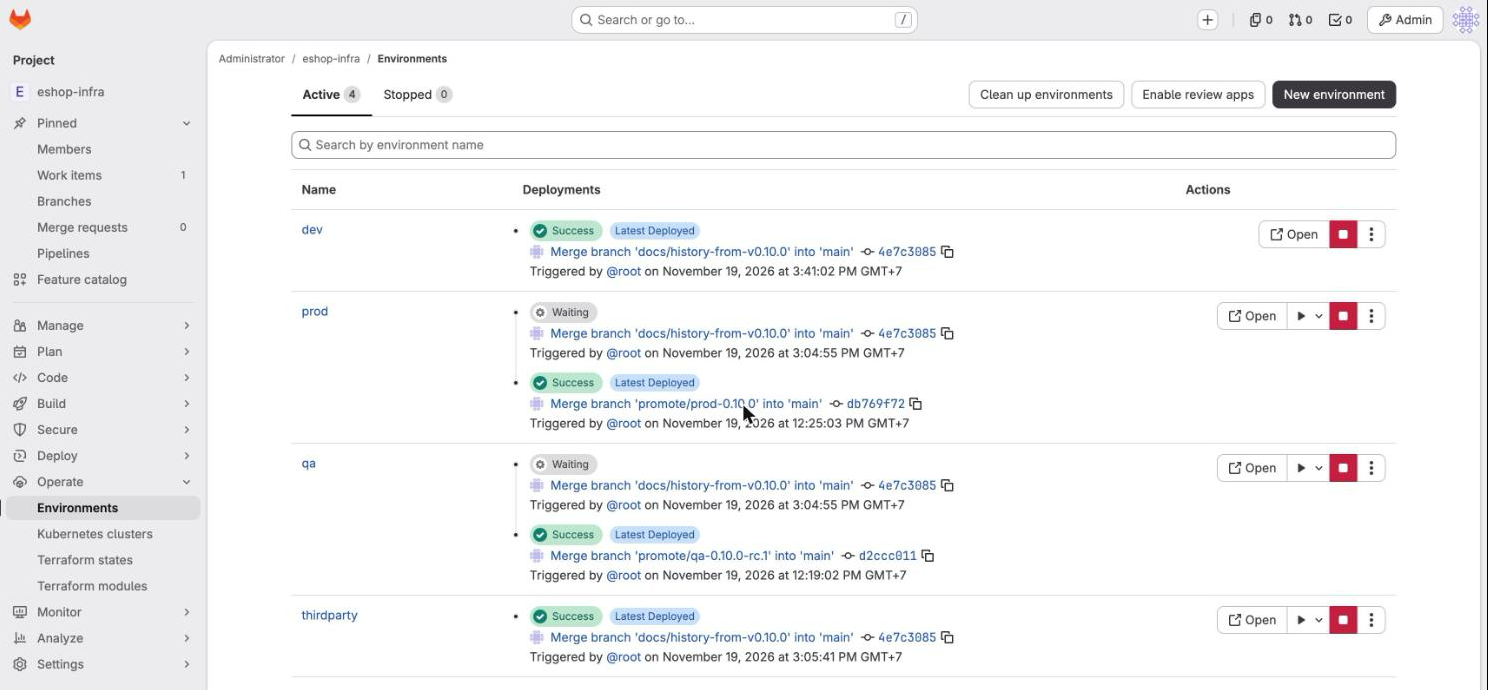
Green "Success / Latest Deployed" means the deploy and its smoke test passed: for prod that's the merge of promote/prod-0.10.0. The grey "Waiting" entries are manual deploy-qa and deploy-prod jobs nobody started, not faults.
Read Flux's state before touching anything
When a deploy waits or fails at Flux, a cluster admin looks at what Flux holds in the eshop-ci namespace:
NAME               URL                                       TAG          READY
eshop-dev          oci://<HARBOR>/eshop/eshop-manifests      dev          True
eshop-prod         oci://<HARBOR>/eshop/eshop-manifests      prod         True
# ...
NAME               READY   APPLIED
eshop-dev          True    dev@sha256:81483203eb11...
eshop-prod         True    prod@sha256:f8be0cd46bed...
Each source should also carry the condition SourceVerified: True ... verified signature of revision ..., which is how Flux reports a cosign check that passed1. A source that says "verification failed" refused an artifact eShop's key didn't sign, and nothing was applied.
Never patch or suspend a Kustomization to unstick a deploy. Suspending is the first step of going back to pipeline deploys, and that's a cluster admin's decision.
Renew CI's kubeconfig once a year, with a script that proves the rights first
The token inside ESHOP_PRD1_KUBECONFIG lasts one year. A cluster admin renews it with ci-kubeconfig.sh:
The script creates the token (kubectl -n eshop-ci create token eshop-ci-reader --duration=8760h), then proves the rights before it replaces anything. These are the questions it asks, and the answers it requires:
list pods -n eshop-prod                                        yes
get secret/eshop-api-staff -n eshop-prod                       yes
get secret/eshop-db-credentials -n eshop-prod                  no
list secrets -n eshop-prod                                     no
patch deployments -n eshop-prod                                no
get kustomizations.kustomize.toolkit.fluxcd.io -n eshop-ci     yes
patch kustomizations.kustomize.toolkit.fluxcd.io -n eshop-ci   no
list pods -n kube-system                                       no
Any failed check, too much or too little, replaces nothing. An expired token can't hide either: the watchdog and the re-scan count a read they can't make as a failed check, never as an empty answer.
The same habit applies to bootstrap.sh, which prints each Helm release's status. A line like ok cloudnative-pg cloudnative-pg-0.29.1 pending-install starts with ok, but the status word isn't deployed. Read the status word.
Renovate keeps the pins moving through the same gates
Everything eShop downloads is pinned: base images and manifest images by tag@sha256:, CI tools by version plus checksum in scripts/ci/tools.sh, Helm charts by exact version. Pinning without updating only trades one risk for another, so two things work as a pair. scripts/gates/pins.sh keeps new pins exact, and Renovate proposes newer ones.
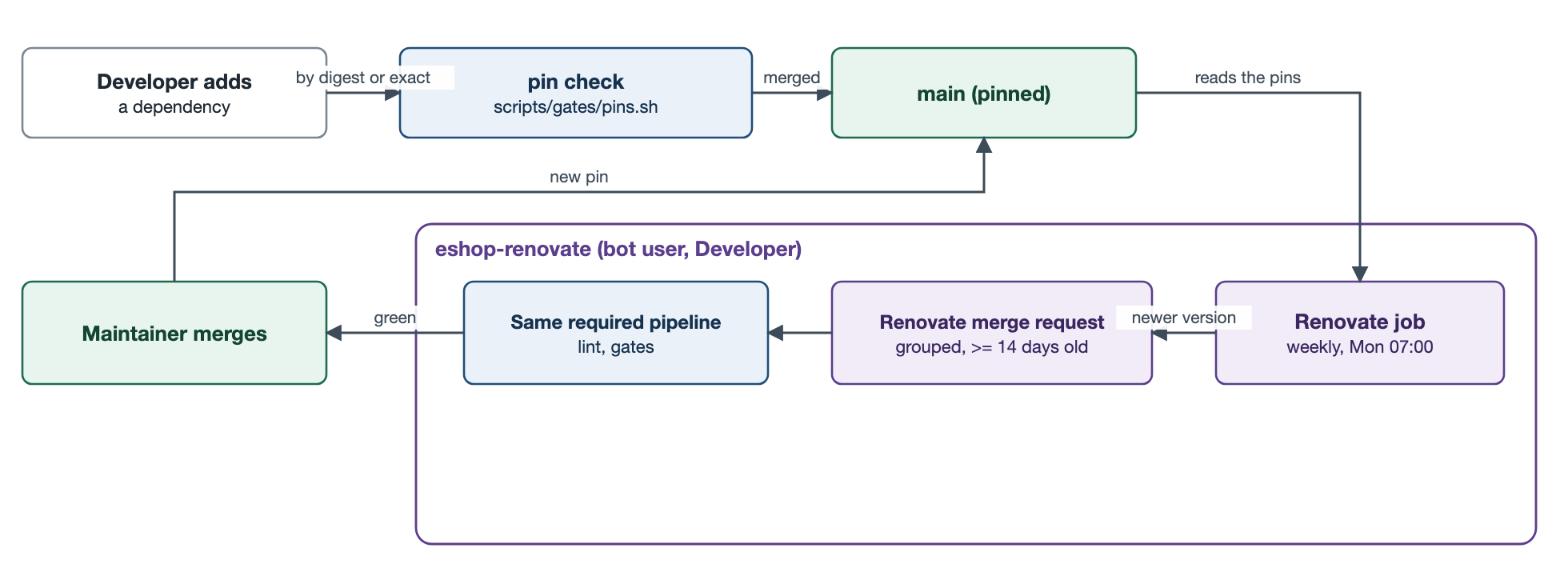
The loop to copy: the pin check guards the way in, Renovate reads the pins every Monday, and its merge request goes through the same required pipeline before a Maintainer merges.
One preset, six repositories
Each repository's renovate.json has one meaningful line: "extends": ["local>root/eshop-infra//renovate/default.json5"]. The rules live once, in eshop-infra/renovate/default.json5:
extends: ["config:recommended", "docker:pinDigests", ":dependencyDashboard"],
timezone: "Asia/Bangkok",
schedule: ["before 9am on monday"],
minimumReleaseAge: "14 days",
separateMajorMinor: true,
internalChecksFilter: "strict",
prConcurrentLimit: 5,
labels: ["dependencies"],
- 14 days of minimum age. Renovate won't propose a version until it has been out for two weeks, and
internalChecksFilter: "strict"holds the merge request back entirely until then2. A withdrawn or malicious release is usually found within days. - One weekly batch. Updates arrive before 09:00 on Monday, grouped as "container images" and "pipeline tools", at most five open per project.
- Majors alone. A major version gets its own merge request with the label
major. Merging it is the approval.
Some pins are deliberately not Renovate's:
| Not updated by Renovate | Why |
|---|---|
| eShop's own images in Harbor | deploys move dev's; promotion merge requests move QA's and prod's |
| cosign 3 and above | v3 writes a bundle format policy-controller can't verify yet (ADR 0011) |
| kubectl's minor and major version | it follows the cluster's Kubernetes version |
Helm chart versions in bootstrap.sh | changed by hand, with the cluster, by a cluster admin |
The first row matters most: which image prod runs is an approval recorded by a named person, never a bot's move.
A scheduled job, a bot user, and a dashboard issue
Renovate runs as the job renovate in eshop-infra's own pipeline, from an image pinned by digest (renovate/renovate:44.188.4@sha256:...), because this GitLab is private and nothing on the internet can reach it. One rule selects it:
rules:
  - if: $CI_PIPELINE_SOURCE == "schedule" && $CI_COMMIT_BRANCH == "main" && $ESHOP_SCHEDULE == "renovate"
That one variable lets one project carry three schedules.
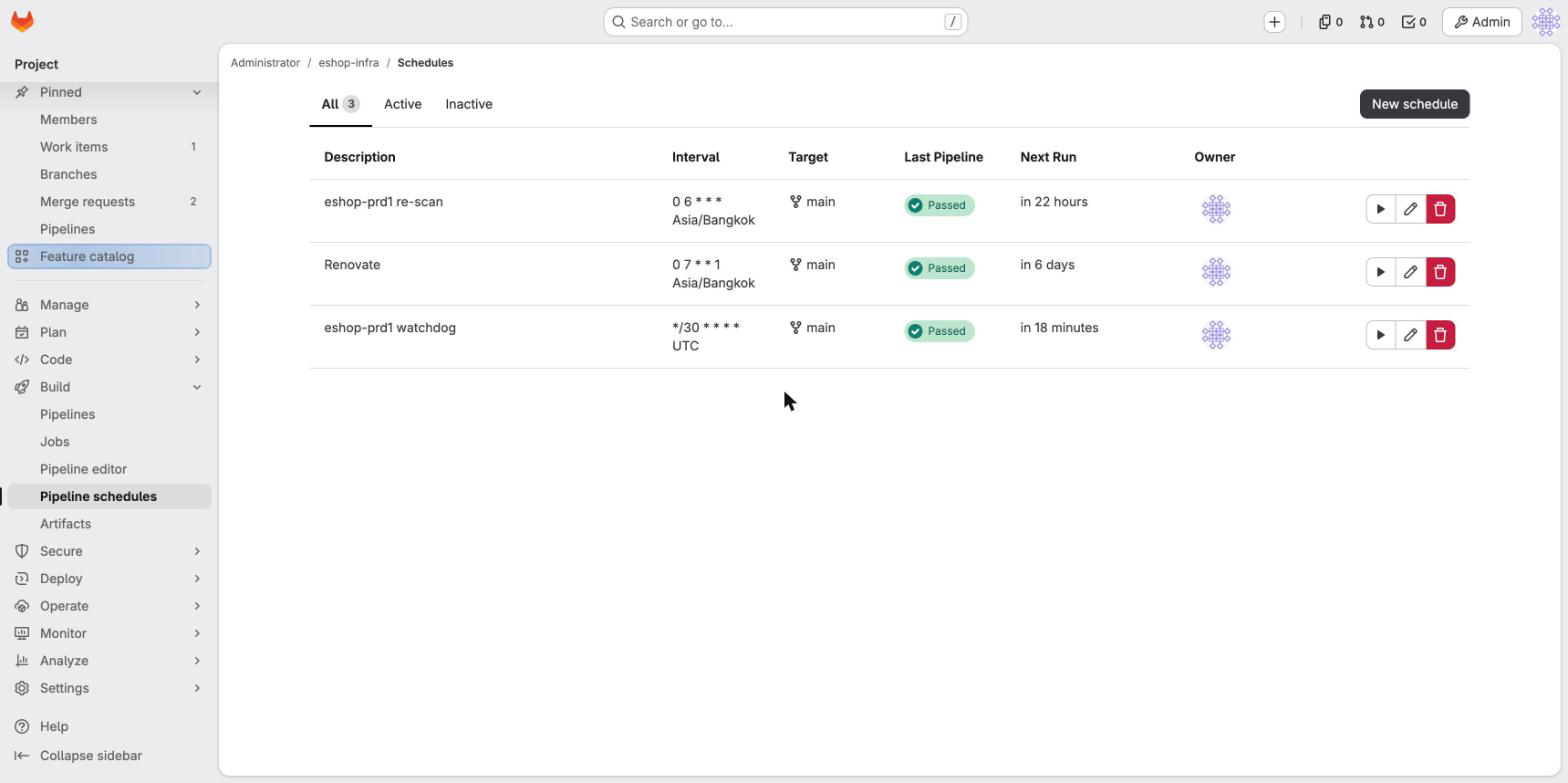
Three schedules, one variable apart: the daily re-scan (0 6 * * *), Renovate (0 7 * * 1, Monday 07:00 Bangkok, inside the preset's window) and the watchdog every 30 minutes.
The identity is an ordinary GitLab user, eshop-renovate, with the Developer role on the six projects. A Developer can't push to protected main, so every update waits as a merge request for a Maintainer.
Renovate keeps one issue per project, the Dependency Dashboard3. It's the first thing to read after a run.
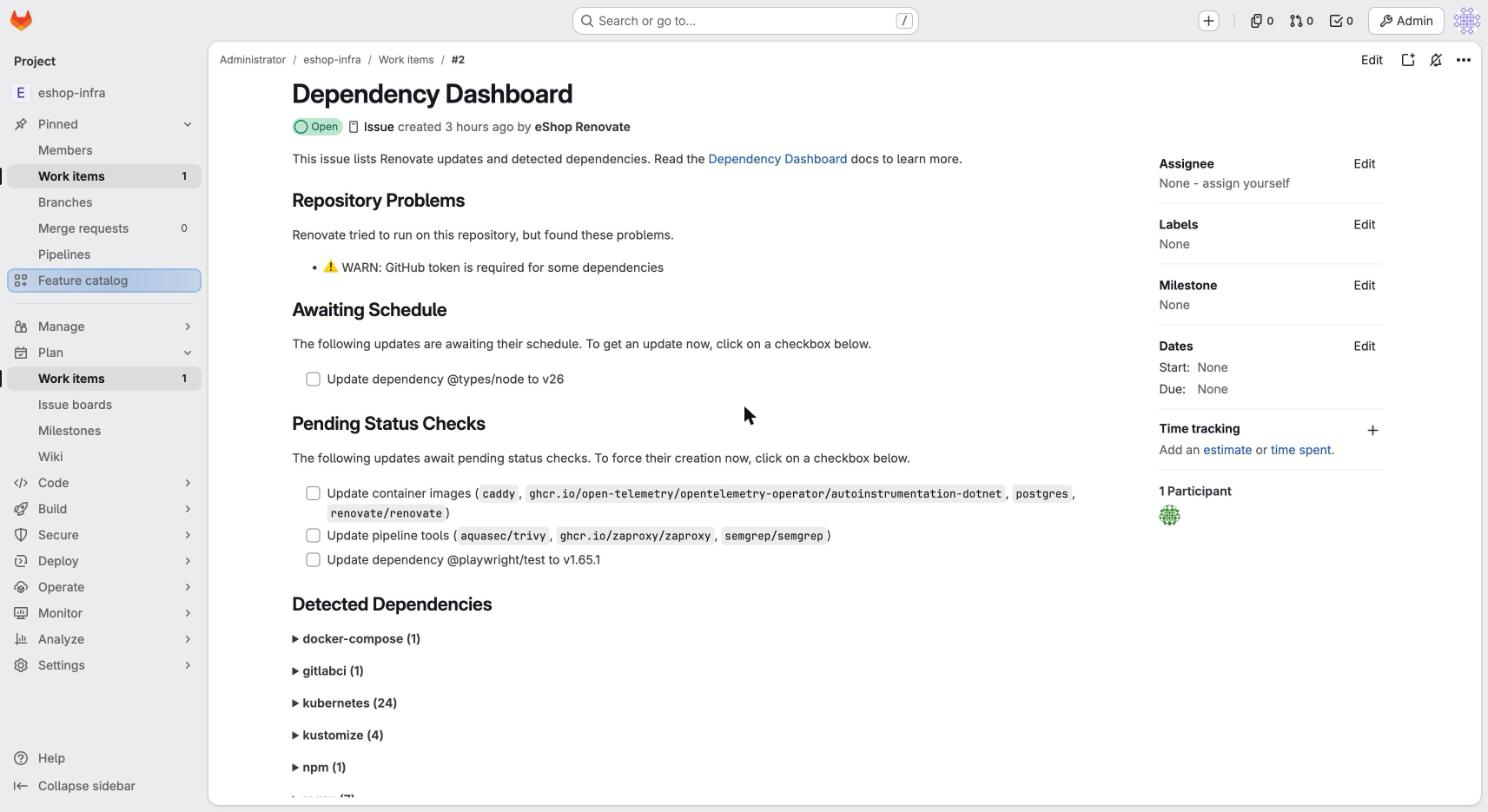
A run can open zero merge requests and be correct: @types/node v26 is a major waiting for Monday, and the three groups under "Pending Status Checks" are younger than 14 days. The GitHub token warning is expected: the job has no GitHub credential, by choice.
How an update flows, and where it needs a hand
- Read the title and labels. For
major, read the release notes before the pipeline result. - Wait for the pipeline. It's the same required pipeline as any merge request.
- If it touches
scripts/ci/tools.sh, finish it: Renovate can bump a version but can't compute checksums. - A Maintainer merges when green, then watches
main.
scripts/ci/tools.sh pin <tool> <version>
git add scripts/ci/tools.sh && git commit -m "Pin <tool> <version> checksums" && git push
That last checkbox isn't optional for image updates. A merge request pipeline doesn't build the image, so a new base image digest is first built, load-tested and scanned after the merge. If a gate fails there, nothing is pushed and dev keeps its image: a red main, not a broken dev.
Pitfall: Node wants the issuing CA, and git wants it too
Renovate can stop at "Authentication failure" with a correct token, while its debug log says "unable to verify the first certificate". Two things cause it.
First, GitLab's own certificate isn't enough. git and curl accept it as a trust anchor, but Node verifies the whole chain, and this GitLab sends only its leaf. The variable must hold the issuing CA's certificate.
Second, NODE_EXTRA_CA_CERTS covers only Renovate's API calls. Renovate also runs git, which needs the same file in GIT_SSL_CAINFO. The job sets both from one File variable, RENOVATE_GITLAB_CA.
The credential map: CI reads, Flux applies, people approve
The repository names every credential by purpose and holds no value. This is the whole map.
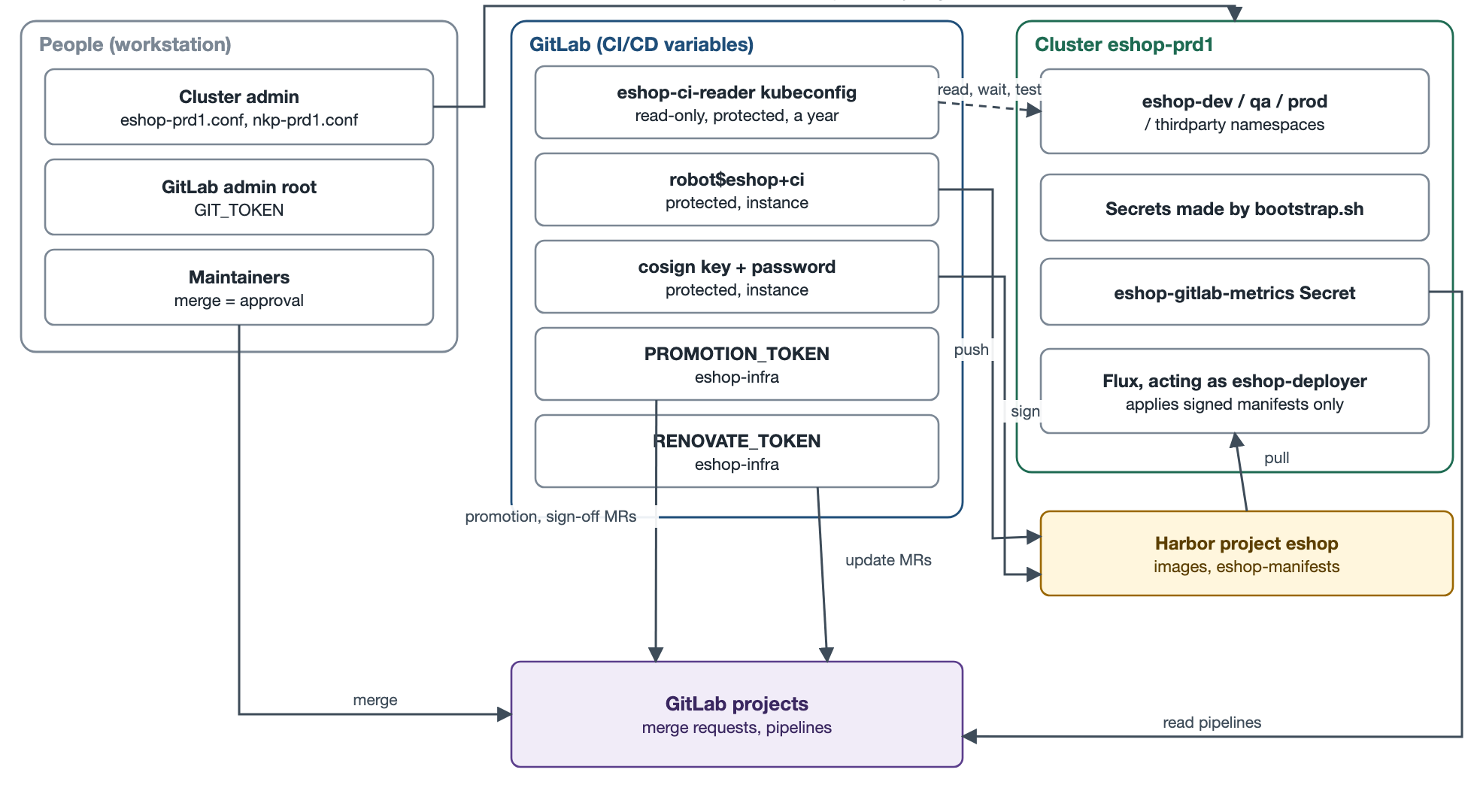
Follow the dashed arrow: the only thing CI holds for the cluster is the read-only eshop-ci-reader. Flux, acting as eshop-deployer, pulls from Harbor and applies signed manifests only.
| Credential | Identity and rights | Where it's kept |
|---|---|---|
eshop-prd1.conf | cluster admin: everything | the admin's machine only |
ESHOP_PRD1_KUBECONFIG | eshop-ci-reader: read-only in four namespaces and Flux's objects, one Secret by name | protected File variable |
| (no credential) | eshop-deployer: changes workloads in four namespaces; Flux acts as it | nowhere outside the cluster |
| a person's read-only kubeconfig | eshop-reader: Kubernetes' view, no Secrets, expires in 24 hours by default | written by reader-kubeconfig.sh |
ESHOP_REGISTRY_USER / _PASSWORD | Harbor robot: push and pull on project eshop | instance variables |
COSIGN_PRIVATE_KEY / COSIGN_PASSWORD | the signing key | instance variables |
PROMOTION_TOKEN | project access token: opens promotion and sign-off merge requests | variable of eshop-infra |
RENOVATE_TOKEN | eshop-renovate: Developer on six projects | variable of eshop-infra |
| metrics token | eshop-metrics: Reporter, read_api | a Kubernetes Secret |
A stolen copy of CI's kubeconfig can read the workloads and one test account's password, and change nothing. A credential that can deploy is always worth stealing, however narrow its rights, so CI holds none: under ADR 0017 ("The cluster pulls its manifests, signed; the pipeline stops applying them") the deployer's identity never leaves the cluster.
The reader's role goes through the gates like everything else. The config gate flags a role that may read a Secret as CRITICAL KSV-0041. The gate isn't weakened for it: scripts/gates/config-accepted.txt holds an accepted entry with a reason and an expiry date (post 03 covers accepted findings).
Protected branches are what make the variables safe
A protected variable reaches only pipelines on protected branches and tags4. In every eShop project main and release/* are protected, and in eshop-infra so are the v* tags.
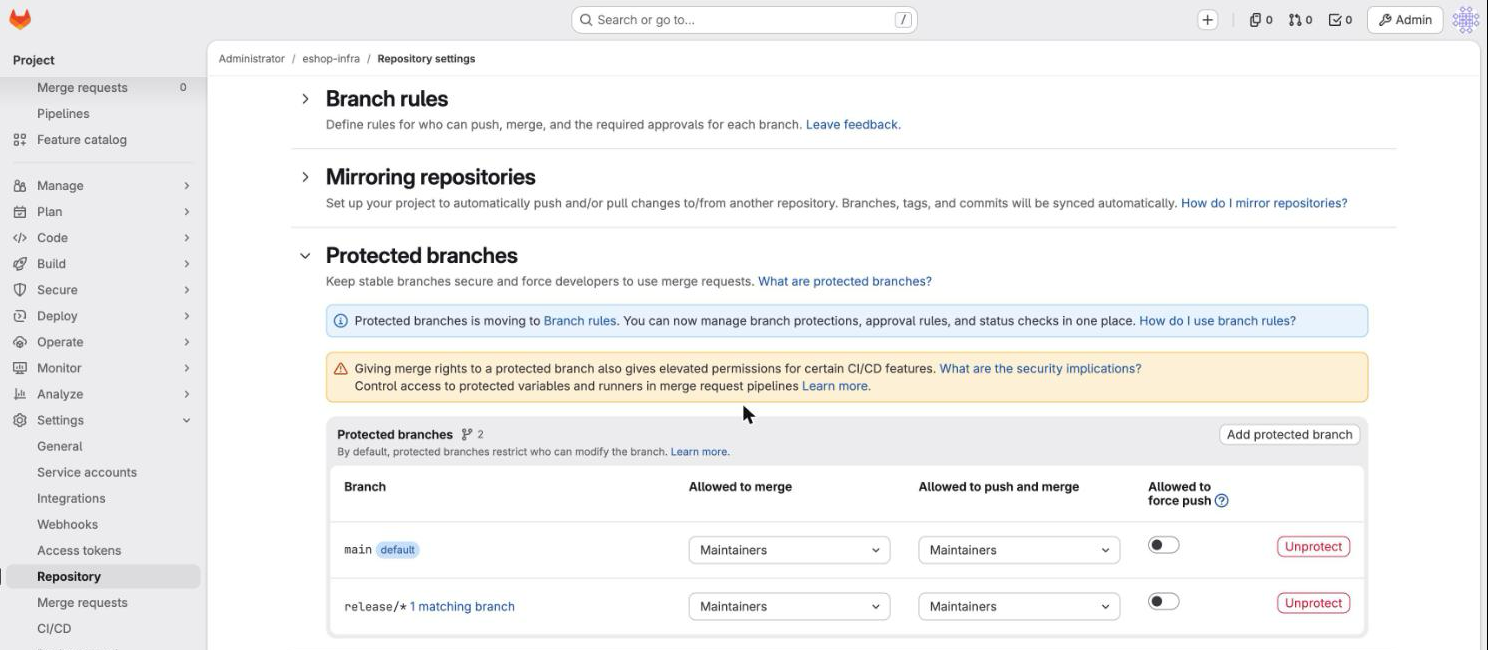
Two rows carry the whole control: only Maintainers merge or push, force push is off. Note what's missing: no rule asks for a second person.
The consequence: a merge request can edit .gitlab-ci.yml to print the signing key, and its pipeline simply doesn't receive it. Masking is the weaker flag. It protects against accidents, not intent.
Runners are part of the access story too, because a job runs with the rights of the machine it lands on.
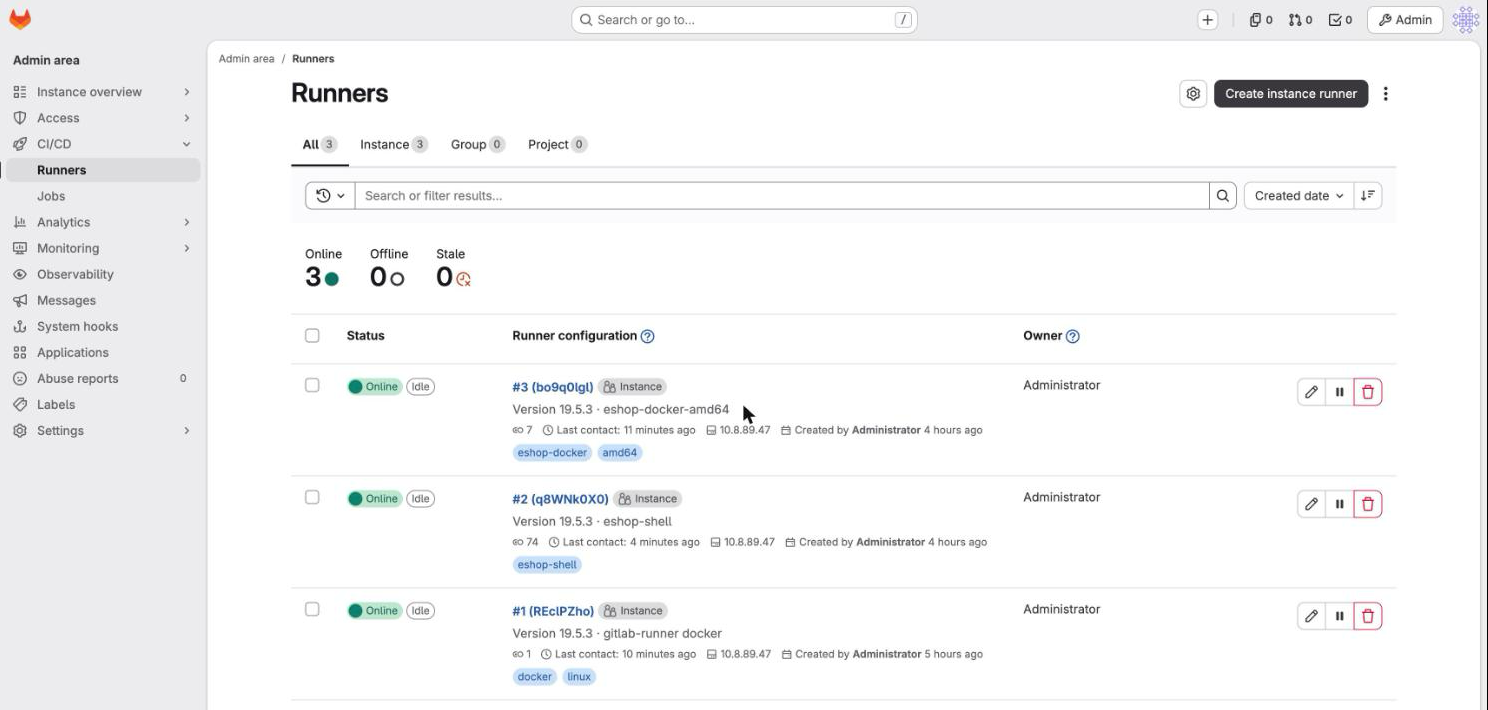
Three runners, one VM. eshop-shell runs the gates, image jobs and deploys (at most 2 at once), eshop-docker-amd64 runs lint and tests, and the docker-tagged runner exists for Renovate.
One key signs four things, so it has a written rotation
One cosign key pair signs images, provenance statements, SBOM attestations and the manifests Flux applies. The private half exists only as a variable; the public half is clusters/eshop-prd1/platform/cosign.pub.
The rotation keeps two keys trusted during the change:
- Generate a new pair and commit the public half as
platform/cosign-next.pub. - Run
bootstrap.sh: both image policies and Flux now trust both keys. - Replace the CI/CD variables.
- Rebuild and release every service.
-
scripts/check-signatures.sh --key clusters/eshop-prd1/platform/cosign-next.pubexits 0. - Remove the old key in one merge request and run
bootstrap.shagain. - Destroy the old private key.
It's yearly, and immediate on a suspected leak. It is written and has not been rehearsed, so treat it as a plan, not a proven procedure.
The human-only steps, and the reason for each
The list is in docs/agents/conventions.md. It was written for coding agents (post 02), but it's equally the list of privileged operations for a team with no agents at all.
| Human-only step | Why |
|---|---|
Anything with the cluster-admin kubeconfig: bootstrap.sh, ci-kubeconfig.sh, reader-kubeconfig.sh, suspending a Flux Kustomization | it can do everything on a cluster shared with NKP's own workloads |
| Creating or renewing CI/CD variables and tokens, including the signing key | whoever can write a variable can replace it |
Touching any *.sops.yaml file | they hold encrypted secrets; a guard hook blocks any command that names one |
Pushing release branches and tags, running scripts/release.sh | a tag starts the release flow and is never moved afterwards |
Merging the sign-off and promotion merge requests, running deploy-qa or deploy-prod by hand | the merge is the approval |
| Any project or instance setting: protections, members, runners, the job token allowlist | these settings are the controls themselves |
The common thread is that an approval must be attributable to a person. If the actor that wrote a change could also merge it, the record would show an approval nobody gave.
The rebuild document adds five "never" rules, each a shortcut that works and removes a control without a trace: never skip TLS verification (curl -k), never mark a registry insecure, never put a kubeconfig or token in a repository or a log, never touch a SOPS file, never print the runner's config.toml.
Troubleshooting starts by naming the layer that refused
A change passes through layers, and each one writes its own message when it refuses: GitLab's workflow rules, a runner, a gate, Harbor, Flux, admission, the rollout, the smoke test, the watchdog. Read the message word for word, find its layer, and look only there.
Distrust a retry that turns red into green without anyone knowing why. It hid a fault.
Here's the method on a red watchdog run right after the first deploys to a new cluster.
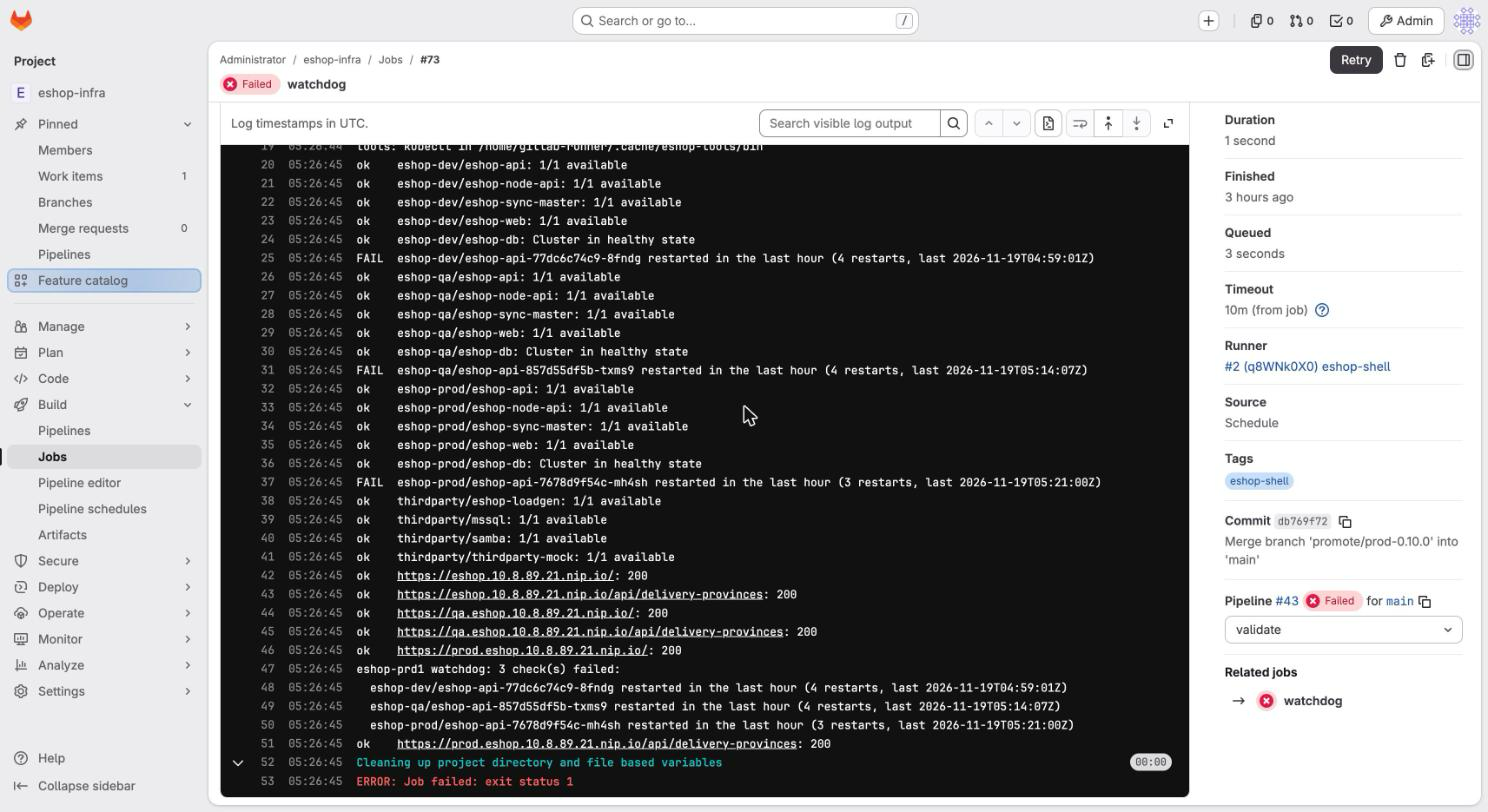
Every Deployment is available and every URL answers 200. The three FAIL lines are all one kind: eshop-api "restarted in the last hour" in dev, qa and prod.
The restarts all fall inside the hour before the job, and they come from the first deploys: eshop-api restarts until its new database answers. The watchdog is right, nothing needs fixing, and the next scheduled run 30 minutes later is the retry.
Every row below is a refusal this system produces.
| Symptom | What it means | Fix |
|---|---|---|
| No pipeline appears | the source or branch is outside workflow: rules; a pipeline from a source the rules don't name is dropped silently | add the source to the rules; a work branch needs a merge request |
| A job stays pending | no online runner has all the job's tags | check the tags; Renovate needs a runner tagged docker |
| Service pipeline stays red after dev was fixed | retrying a pipeline doesn't re-run its deploy bridge job | retry the deploy job itself |
Flux refused the artifact | the manifests' signature doesn't verify with the key Flux holds; nothing was applied | compare cosign.pub with the key CI signs with; don't re-run until you know why |
Flux did not apply ... within 15 minutes | Flux is slow, stopped, or the Kustomization is suspended | read Flux's state (above) |
could not read the OCIRepository eshop-ci/eshop-<env> | Flux's objects are missing | a cluster admin runs bootstrap.sh (step 5b) |
CreateContainerConfigError under "containers that are waiting" | a Secret is missing; the deployer can't read Secrets, so it shows only at rollout | a cluster admin runs bootstrap.sh |
Pod refused by policy.sigstore.dev, rollout times out | the image was pushed while the signing variables were missing; the image job pushes unsigned and doesn't fail | fix the variables, run main again for a new signed image |
secrets gate: FAILED on a file that's gone | gitleaks reads every commit the merge request adds; "removed since" still counts | real: revoke first, then remove. Not a secret: accept with a reason and a date |
config gate fails with Blocking lines | a HIGH or CRITICAL misconfiguration, or a resource invalid for Kubernetes 1.36.2 | fix the manifest, or accept it with a reason and a date |
commits gate: FAILED: N unsigned commit(s) | a commit of the merge request has no signature | git rebase --exec 'git commit --amend --no-edit -S' <base>, push again |
| A gate fails though nobody changed anything | an accepted entry passed its until date (ADR 0016, "Accepted findings expire") | fix the finding, remove the entry, or renew the date with a reason that's still true |
| PostgreSQL pods replaced in a loop | the image policy's webhook rewrote a tag into tag plus digest; CloudNativePG saw a "different" image | name the image by digest so there's nothing to rewrite |
| Container stops with "permission denied" | the runner's umask made files unreadable to the image's non-root user | COPY --chmod=u=rwX,go=rX in every Dockerfile |
| "unable to verify the first certificate" | the tool doesn't have the right CA | give it the CA file; Node needs the issuing CA |
no such file or directory for kubectl, in zsh | the command was kept in a variable | write it out, or export KUBECONFIG=<file> |
That last one is a zsh trap. With K="kubectl --kubeconfig <file>", the command $K apply -f ... fails: zsh doesn't split a variable's value into words, so it looks for one program with that whole name. Bash would split it.
The expiry row deserves a note too. Every accepted finding ends with | until YYYY-MM-DD, at most a year ahead. For 30 days before, the gate's summary lists the entry under "Entries expiring within 30 days", so the red day is never a surprise.
The system can be recreated from the repositories
The whole system can be recreated on a new environment by following eshop-infra/docs/rebuild-on-a-new-environment.md: a new NKP cluster, GitLab, runner VM and Harbor, all at new addresses.
A recovery plan that was never run is a guess. A rebuild shows what's truly in Git and what only lives on a server.
A person provides the preconditions before anything starts:
- The environment, installed and reachable: an NKP cluster named
eshop-prd1, GitLab CE, a runner VM, Harbor 2.8 or newer. - NKP's own
cloudnative-pgapplication is not enabled. -
new-addresses.envwith the six new addresses. - The cluster-admin kubeconfig and the credentials in a workspace folder, never in a repository.
Four decisions shape it:
| Question | Decision | Consequence |
|---|---|---|
| Harbor | new, at a new address | every image name changes; nothing is copied |
| The old environment | gone before the new one exists | every image is built again from source |
| GitLab's history | code only | issues, merge requests and pipelines aren't carried over |
| The addresses | search and replace | one script, then a short list of exceptions |
What survives is six clones on a workstation. The signing key doesn't, since it exists only as a masked variable, so each environment gets a new key pair.
Nine phases, each ending with a check
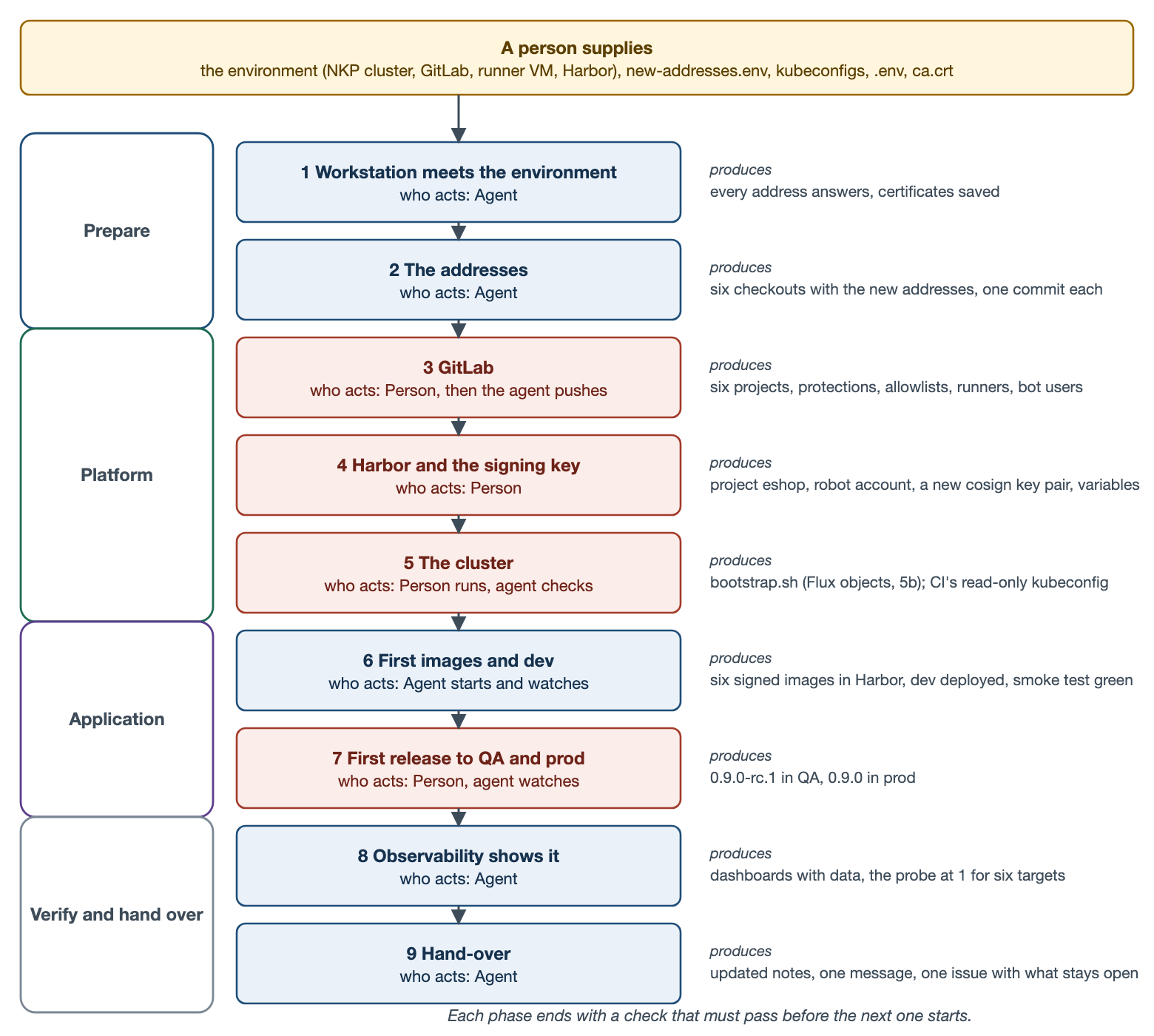
Red phases need a person: GitLab settings, the signing key, the cluster bootstrap, the release. Read each row for who acts and what the phase produces.
The next phase doesn't start before the previous check passes. A team without agents reads "agent" as "an engineer without admin rights".
Why not one big automation? The steps that create trust (comparing a certificate fingerprint, creating tokens, generating the signing key, merging the release) are a person's by rule. Full automation would have to hold the very credentials the rules keep away from it.
The address-move script
Harbor and GitLab are named by IP in every pin, policy glob and include (ADR 0012), so a move is a rewrite:
eshop-infra/scripts/move-addresses.sh --check new-addresses.env <the six checkouts>
eshop-infra/scripts/move-addresses.sh new-addresses.env <the six checkouts>
eshop-infra         318 address(es) in 61 file(s) (not changed: --check)
                     13 left as they are in releases/

318 address(es) would change.
It replaces all six addresses in one pass, refuses a repository with uncommitted changes, commits nothing, and leaves releases/ alone, because a release record says where a release ran. QA's and prod's pins name digests that no longer exist, so both environments are suspended until the first promotion.
Pitfalls, and the guard in place for each
| Pitfall | Why it happens | The guard in place |
|---|---|---|
| The address rewrite reports success but misses addresses | inside regular expressions the dots are escaped | move-addresses.sh matches each dot escaped or not; the phase's git grep check doesn't depend on the tool |
| Jobs fail on a hardened runner image | umask 027 leaves files unreadable to an image's non-root user, and /tmp is mounted noexec | COPY --chmod in every Dockerfile; TMPDIR set for the runner |
| Two CloudNativePG operators on one cluster | NKP's own cloudnative-pg application owns the CRDs | a precondition: that application is not enabled |
| Sign-off is refused | a manual deploy-qa nobody started counts as QA's latest Deployment | scripts/lib/qa.sh skips a blocked Deployment, with a test |
| NKP platform applications are accepted and deployed nowhere | an AppDeployment without a selector targets no cluster | each AppDeployment needs spec.clusterSelector naming the cluster |
A Helm release sticks at pending-install | bootstrap.sh over a slow VPN: a 1 MB Helm release times out | run bootstrap.sh on the runner VM, next to the cluster |
| The first pipelines fail on a new runner | two pipelines race on an empty tool cache | start the first service pipeline alone |
| Grafana shows no eShop data sources | Grafana reads its data sources once, when it starts | restart Grafana once after the first bootstrap |
| The tracker has no triage labels | labels live only in GitLab's database | phase 3, step 9 creates all 14 through the API |
Two guards generalise. A replacement tool's check must not depend on the tool. And anything kept only in GitLab's database, like labels, needs its own step.
One precondition isn't in the document: NKP's Flux. Add kubectl -n eshop-ci get ocirepository,kustomization to phase 5's check and expect four of each.
The honest part: known gaps
This is a rebuild, not a restore. It proves the system can be recreated from source and proves nothing about data, because no data is carried over.
eShop records a "no" in two places: eshop-infra/.out-of-scope/ for rejected requests, and the ADRs. These are the gaps I'd want to know before copying any of it:
- SLSA Build Level 1, Level 2 only in part. The job writes and signs its own provenance with a key it can read, and one shell runner builds everything with a shared cache5.
- Every signature goes to the public Rekor log. That's a decision recorded in ADR 0011's note, but signing needs the internet and leaves a permanent public record.
- The signature check fails open. If the policy webhook is down, pods are admitted unchecked.
- One person can merge their own merge request. GitLab CE can't require an approval, and
CODEOWNERSis only a record. - No database backup, one replica of everything. Prod's data exists once, on one volume.
- Nobody is notified. Ten alert rules are evaluated; email is off by decision. Someone has to look.
- Rollback moves images, never data. Migrations only go forwards, and no release before 0.10.0 can be rolled back to.
- The heavy gates run after the merge. A failure there leaves
mainred until someone fixes it. - Gate reports expire in 30 days, before the release they justify stops running.
- One runner VM and one cluster admin. If either is away, builds or platform changes wait.
This lab, and what production would change
The delivery design carries over unchanged: gates before an image exists, promotion by merge request, digests, signed-off records, a cluster that pulls signed manifests while CI only reads. What doesn't carry over:
| Topic | This lab | What production would change |
|---|---|---|
| Image signing | key pair in a CI variable, public Rekor, rotation not rehearsed | keyless signing through the organisation's identity provider6, or a key in a KMS; a private log or none |
| Builds | one shared shell runner; the job signs its own provenance | isolated, single-use builders; provenance the build can't forge (SLSA Build Level 3) |
| Approvals | the merge is the approval; one maintainer | a second reviewer required; code owners enforced; named approvers for QA and prod |
| Deploy credentials | CI reads only; one Flux and one deployer for all four namespaces | the same pull model, one Flux and one deployer per cluster |
| CI's cluster token | one year, renewed by hand | short-lived, issued per pipeline through identity federation |
| Environments | one cluster, three namespaces | prod on its own cluster or node pool |
| Runners | one VM, shell executor | several runners, split by trust level |
| Names and TLS | nip.io names, private CAs, IP addresses in 300+ places | real DNS, a CA clients already trust |
| Secrets | random values from bootstrap.sh, only in the cluster | an external secret store with rotation |
| Backups | none | scheduled backups, practised restores |
| Availability | one replica, one PostgreSQL instance | replicas across nodes, standbys |
| Alerts | evaluated, nobody notified | routed to an on-call rota |
| Policy webhook | fails open | fails closed, with enough replicas |
Treat each row as a decision to make, not a setting to copy. And notice which side is cheap: a second replica is a line in a manifest, while a promotion process is a change of culture. That's why the lab puts its effort into the second.
Summary
The whole series as one adoption checklist. Start at the top; each post builds on the one before.
- Draw your path from an issue to production on one page, with every repository, environment and approval on it.
- Make the merge the approval, and write down which steps only a named person may take.
- Keep triage labels and conventions as files in Git, not only in the tracker.
- Run each gate from one script that works the same locally and in CI.
- Give every accepted finding a reason and an expiry date.
04: Image gates and the supply chain
- Start, test and scan the image before it's pushed; sign exactly the digests you pushed.
- Attach an SBOM and provenance to every image, and keep one page of what is not done.
- Pin releases by digest and promote them with merge requests, including rollbacks.
- Let the cluster pull signed manifests so CI only reads.
- Put every cluster-admin step in one re-runnable script that checks before it acts.
- Enforce the image policy from the first pod.
- Smoke-test every deploy, and run a watchdog that treats a failed read as a failed check.
- Write down every expected red, so people don't learn to ignore red.
08: Operations and caveats (this post)
- Keep runbooks in the repository, each ending with a check.
- Pin everything, then let a bot propose updates through the normal pipeline.
- Map every credential by purpose, and put its expiry date in a calendar.
- Rebuild from the document on a schedule, and fix the document the same week.
- Publish your own list of gaps before someone finds them in production.
Start over: Post 01: The system on one page
-
Flux, OCIRepository:
.spec.verifyenables Cosign signature verification and sets theSourceVerifiedcondition. ↩ -
Renovate, Minimum Release Age: how
minimumReleaseAgeandinternalChecksFilterhold back young releases. ↩ -
Renovate, Dependency Dashboard: the issue that lists pending, scheduled and detected updates. ↩
-
GitLab, CI/CD variables: a protected variable "is only available in pipelines that run on protected branches or protected tags". ↩
-
SLSA, Security levels, v1.0: Build L1 to L3 and what each requires of the build platform. ↩
-
Sigstore, Signing overview: keyless signing with Fulcio's short-lived certificates and the Rekor transparency log. ↩
Discussion
Have thoughts on this post? Share them below — questions, corrections, or your own experience are all welcome.